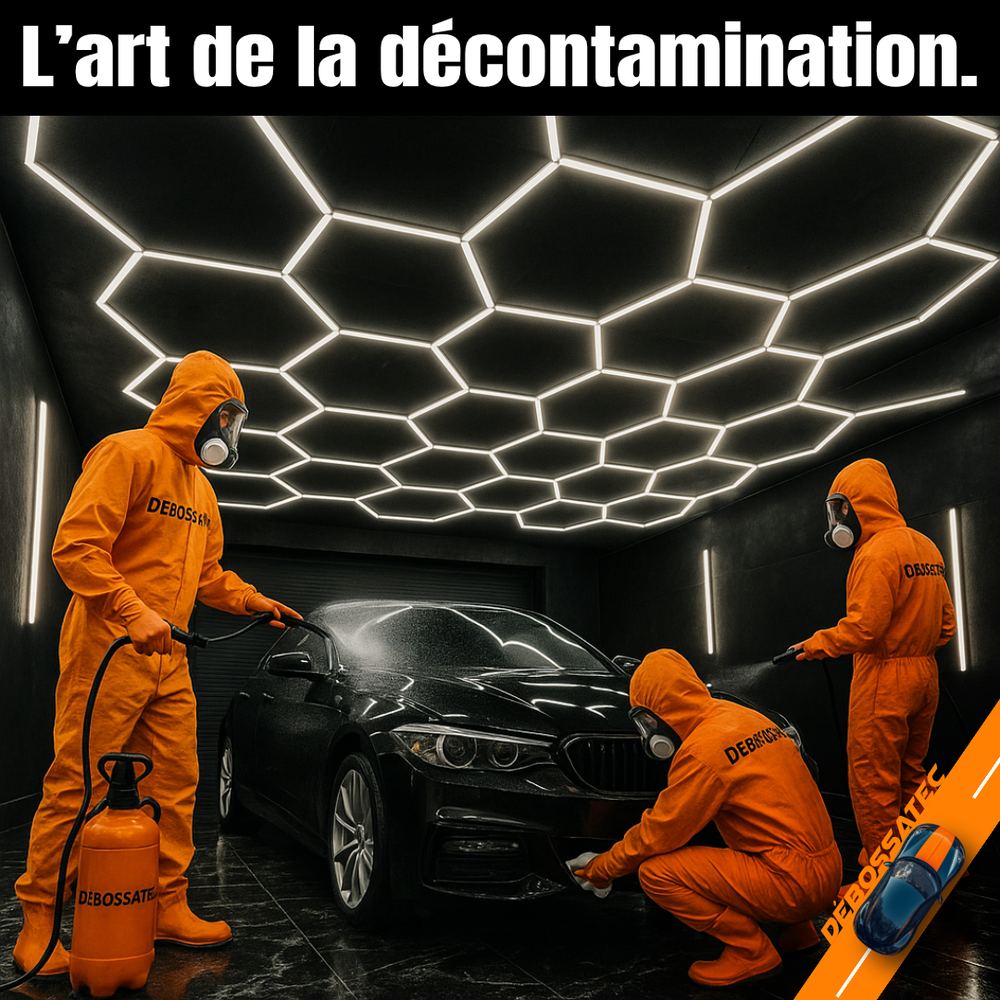
Even if your car has been washed carefully, the surface can still be hiding invisible enemies. Brake residue, metal particles, tar, industrial fallout… These microscopic contaminants stick to the paint and, over time, can damage it or keep protective products like a sealant or a ceramic treatment from bonding properly.
Why decontaminate after a wash?
A wash takes off the visible dirt, but plenty of contaminants stay stuck to the surface, or even lightly embedded in the pores of the clear coat. These particles are usually invisible to the naked eye, but you can feel them by running your hand gently over the bodywork: it doesn’t glide? Then it’s contaminated.
Chemical decontamination: dissolving the invisible particles
The first step is chemical. We apply an iron remover, made to dissolve the metal particles that come mainly from brake dust. These products react on contact with iron and turn purple: it looks spectacular, and above all it works!
Then we can use a tar remover to target tar spots, often found behind the wheels or on the rocker panels. It works by softening the deposits so they lift off without damaging the paint.
Mechanical decontamination: deep smoothing with the clay bar
Once the chemical contaminants are gone, stubborn impurities sometimes remain that only a mechanical decontamination can take off. That’s where the famous clay bar comes in.
Used with a lubricant, the bar is worked gently over the bodywork. It acts like a soft eraser that picks up the last impurities. The result? An ultra-smooth surface, ready for paint correction or a protective treatment.
Is it really worth it on every vehicle?
Yes, especially if:
- Your vehicle sleeps outside.
- You often drive on the highway or in the city.
- You feel a gritty texture when you touch the paint, even after a wash.
A decontamination done right prevents micro-scratches during polishing and improves how well paint protection holds. It’s a key step for anyone who wants a finish that lasts and looks flawless.
🔧 At Débossatec, we don’t just wash cars. We prep them properly so paint treatments last as long as they can. If you’ve never had a full decontamination done, your paint will thank you.
📍Next step: correcting the defects (polishing).