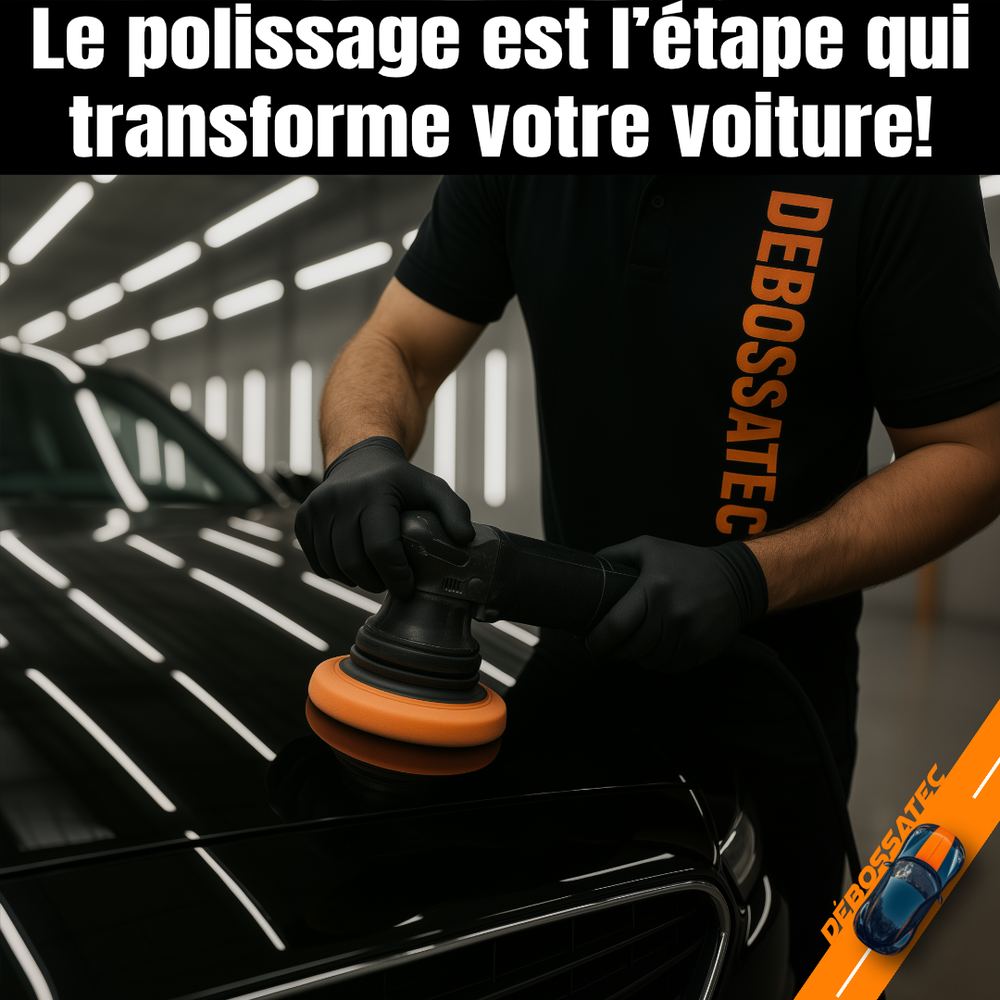
Even after a good wash and a full decontamination, paint can still look flat. That’s where polishing comes in: a key step to correct the visible defects and bring back the original beauty of the finish. Correct, polish, make it shine!
Over time, bodywork picks up micro-scratches, circular marks (swirls), water spots and even light oxidation. Polishing corrects these flaws by working the surface of the clear coat, without damaging the paint.
Polishing is an art
It isn’t a job you improvise. Polishing takes time, precision and, above all, practice. In the right hands, the polisher becomes the technician’s paintbrush. You have to know the materials, master the right movements and respect the curves of the vehicle.
Like in any craft, every detail counts: pressure, angle, duration, choice of pad, product and speed. That level of mastery isn’t learned in a day — it builds with experience, observation and a passion for work done right.
The secrets of a good professional polish
At Débossatec, here’s what makes the difference:
- Understanding how hard the clear coat is: every car brand has its quirks.
- Choosing the right pad + compound combo: cutting or finishing, foam or microfibre.
- Working slowly, in small sections: full control, no overheating.
- Always doing a test spot: better to check first than to polish blind.
- Using an inspection light: the real defects don’t always show up to the eye
- Respecting the edges: they often call for careful hand work.
- Using clean, soft microfibres.
- Never polishing before a full decontamination: otherwise you make things worse.
- Finishing with a refining pass: to get the most clarity and gloss.
A result that speaks for itself
When the polishing is done right, the bodywork turns almost into a mirror. The colours are deeper, the reflections sharper, and the surface is ready for lasting protection like a sealant or a ceramic treatment.
Want to see what professional polishing can do on YOUR car? Come see us!
We’ll take the time to assess the condition of your paint and walk you through the right steps to take.
And stay tuned: in our next article we get into step 4 – protection, where we look at synthetic sealants, waxes and ceramic coatings.
See you soon at Débossatec, where every detail counts.