Your car’s paint isn’t only there to make it look good: it also acts as a protective barrier against the elements. Good cosmetic upkeep keeps the shine, slows down wear and raises resale value.
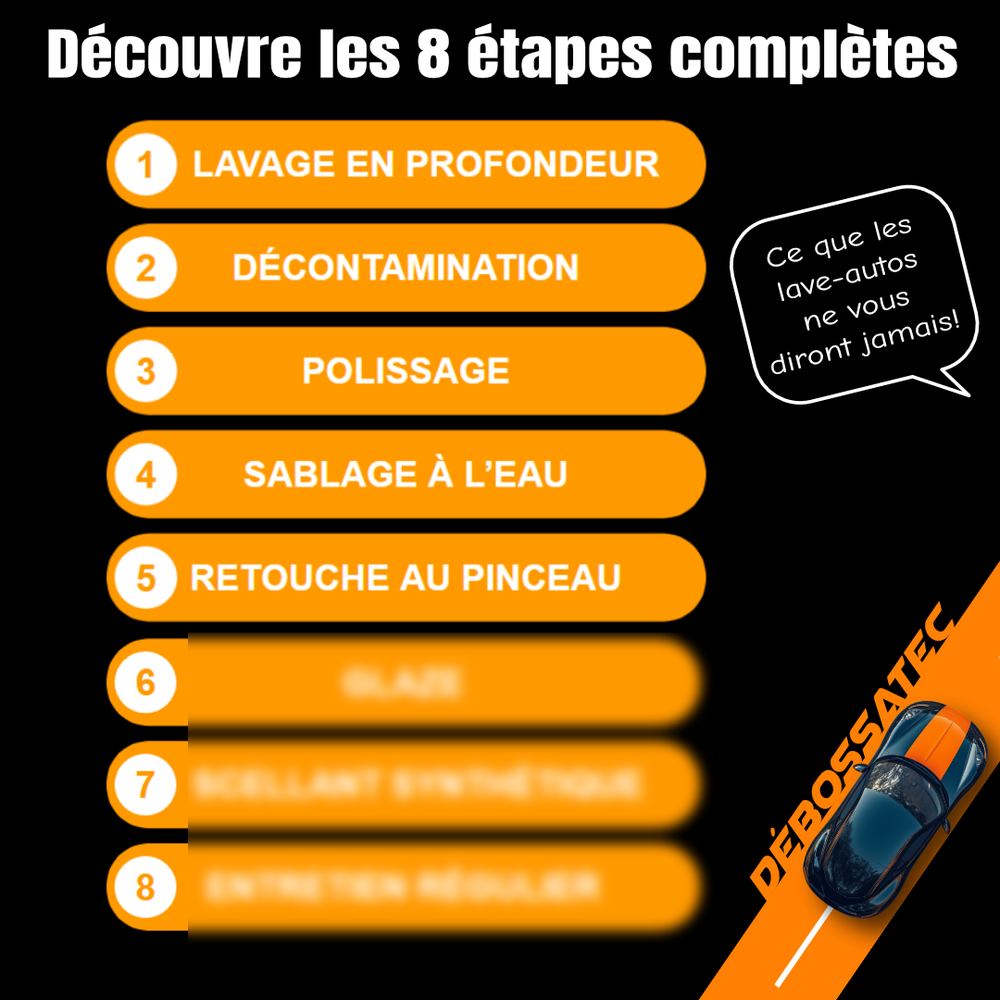
At Débossatec, we follow a rigorous 8-step approach to bring your bodywork back to life.
Here’s an overview of our full process. In the coming articles, we’ll go through each step so you understand what it’s for… and know when the work is better left to a professional.
🧼 1. Deep wash
This is the foundation of everything. A good wash takes off the dirt without damaging the surface. We use a pH-neutral soap, safe techniques (like the two-bucket wash) and microfibre mitts to avoid micro-scratches.
🧲 2. Decontamination (chemical and mechanical)
Even after a wash, contaminants can stay embedded: brake dust, tar, industrial fallout… We use specialized products (iron remover, clay bar) to take off what’s invisible but harmful.
🪣 4. Wet sanding
Wet sanding is an advanced technique used in very specific cases:
- Removing orange peel (textured paint)
- Toning down runs or defects left after a touch-up
- Correcting deep scratches (when polishing is no longer enough)
🔧 Avoid it on clear coats that are too thin or on fragile areas. Used badly, it can go right through the clear coat.
✨ 3. Polishing (paint correction)
This step corrects the visible defects: micro-scratches, oxidation, swirls left by bad washes. We use professional polishers and different types of compound depending on the condition of the paint.
🖌️ 5. Touch-up by brush
Used to hide stone chips or small impacts, this technique means carefully applying touch-up paint to the damaged spots.
💎 6. Glaze
Glaze gives a temporary mirror effect and can mask some leftover micro-scratches. It goes on after polishing, to soften the abrasion from the compound and prep the surface for the sealant or the wax.
🛡️ 7. Synthetic sealant
This is our best barrier against the invisible daily attacks. It forms a durable protective layer that repels water, UV, salt and contaminants. Unlike a wax, a sealant gives extended protection with a smooth, glossy finish.
🔁 8. Regular upkeep
Once the paint is protected, you have to take care of it:
- Gentle washes
- Quick finishing products (quick detailer)
- Reapplying the sealant every 6 to 12 months
These habits keep a professional finish looking good longer.
👉 Coming up: a detailed article for each step
In the coming articles, we’ll explain each step in detail: how it works, the situations where it’s useful, and the common mistakes to avoid.
✅ Follow our page so you don’t miss a thing!
📍 And if you’d rather leave it to the pros, come see us at Débossatec!